
AI-driven job disruption, rising debt, shrinking savings and a changing global economy are reshaping India's middle class. Saurabh Mukherjea discusses jobs, entrepreneurship, investing and the future of India's economic growth on THE REDIFF PODCAST.

Saurabh Mukherjea, CEO, Ambit Capital, says he is advising clients to either take a genuinely long-term view on stocks or diversify the portfolio with stocks, bonds and gold for those with a short-term view.

IT stocks had their worst first half fall in decades, with the Nifty IT index declining 31% in the January-June 2026 period, its biggest decline in the first six months of a calendar year since 2003.

'In India's case, an extended earnings slowdown accompanied by rich valuations have dimmed returns since late 2024.'

Foreign investors have remained cautious ahead of the Union Budget amid expectations of limited policy changes.

'When AI comes in, coders in Bangalore or Hyderabad will lose their jobs.'

'More and more people from the middle class will become self-employed gig workers mostly working from home, rather than as office workers with salary, promotion, bonuses, etc.'

'...you evaluate three key factors before committing your money.'

'Expect FPIs to continue selling for several months until the rupee stabilises.'

After a brutal selloff since October, foreign portfolio investor (FPI) flows for the year-to-date (YTD) in 2024 have turned negative. In early September, YTD FPI investments peaked at a record Rs 22,000 crore ($2.6 billion). This wave of selling has also pulled down benchmark indices, with the Nifty's YTD returns declining to 11 per cent from their high of 21 per cent in September.

Rupee depreciation, if it continues, will likely pull the markets down further. Since September 2024, the rupee has declined by 3.1 per cent, the Nifty has dropped by 8.5 per cent during the same period, and the Sensex has fallen by 7.3 per cent. If the decline continues, markets will need to brace for more pain as it could push foreign portfolio investors (FPIs) to exit their positions faster than anticipated.

'Peninsular Indians could ask 'Why should we contribute half of India's tax revenues if we account for only a quarter of the seats in the Lok Sabha?'.' 'The rest of the country seems likely to counter that 'democracy means one vote per person irrespective of where that person resides in India'.' 'With no easy answers to this thorny debate, the south's economic ascendancy could end up creating a Hobson's choice.' A revealing excerpt from Nandita Rajhansa and Saurabh Mukherjea's book, Behold the Leviathan: The Unusual Rise of Modern India.

'The economy is clearly at a very soft spot, and earnings growth is disappointing every day.' 'After three great years, the Indian economy has hit a rough patch.'

The top 100 companies have accounted for 63% of the gains (Rs 51 trillion out of Rs 81 trillion), while firms beyond the top 100 have contributed 37 per cent (Rs 30 trillion).

A combination of strong earnings and economic growth, and hopes of the Federal Reserve ending the rate-hike cycle have pushed gross buying of Indian equities by foreign portfolio investors (IPO) to a new high. In 2023, FPIs have been gross buyers of shares worth Rs 25.5 trillion, the highest ever in a calendar year. FPIs also sold shares worth Rs 23.9 trillion. On a net basis, they were net buyers to the tune of Rs 1.6 trillion, the highest since 2020.

It was a roller-coaster week for the markets, amid talk of a fiscal stimulus by the government. Saurabh Mukherjea, chief executive officer, and Prashant Mittal, strategist, at Ambit Capital tell Puneet Wadhwa the recent flows into equity mutual funds are largely speculative in nature and pose a risk of reversal.

'The consolidation of the world's fifth-largest economy in the hands of 15-20 corporate giants is a once-in-generation event, which we are focusing on.'

The Sensex, which began the year at 26,160.90 level, has shed nearly 1,400 points.

The crackdown on black money has manifested itself in a doubling in outward remittances as black money attempts to leave India.

Returns on capital harder to sustain as debt levels rise; responsibility for this invariably of firms themselves

'The true fruits of the attack on black money, what Raghuram Rajan did for the banking system, and what technology is doing for us will come in FY19, which, not surprisingly, is the year running up to the next Lok Sabha elections.'

These have always been pro-cyclical bets but new banks could erode RoEs.

The country's dash to a $3-trillion market cap is more a case of teamwork, than a few members doing most of the heavy lifting. Sample this: The share of top 100 companies to India's total market cap (BSE-listed companies' m-cap) is 67.3 per cent currently, less than what it has been when the nation hit previous milestones, such as $1 trillion, $1.5 trillion in 2007 or $2.5 trillion more recently in December 2020. In 2007, when India's m-cap topped the $1-trillion mark for the first time, the top 100 companies accounted for three-fourths of the total m-cap; at $1.5 trillion, the share was almost 80 per cent.

Given the developments, analysts expect fiscal and monetary support from the government and RBI to revive sentiment. However, recovery, they say, from these levels will be slow and painful.

Modi sarkar will have to undertake reforms to prove its mettle.

Sensex gains 2.4%, Nifty crosses 7,000; investors feel exit polls have vindicated their stand

So far this month, another $4.5 billion (Rs 33,000 crore) has flown into domestic stocks.

The market breadth has turned sharply positive since May amid hopes that a decline in Covid-19 infections will lead to a revival in the economy. At 3.8, the advance-decline ratio (ADR) for May was the best since June 2020. So far this month, the ratio has remained above three - in simpler words, for every declining stock, there were nearly four advancing stocks in May and three this month. ADR is a popular market breadth indicator, with a ratio of more than two signalling an extremely bullish undercurrent.

Sticking to smaller and mid-cap companies can be more fruitful, suggests Devangshu Datta.

Based on a feedback, the exchange could cap a sector's weight at 25 per cent, or align with the broader market.

'Thankfully, most investors in India have now seen through this false narrative and are once again deploying their hard-earned money.

The V-shaped rebound has been aided by a gush of liquidity flooding the global financial system, thanks to balance sheet expansion.

India's rapid economic progress over the past two decades masks its abysmal performance on social indicators.

Experts, however, caution that though the moves are positive for the sector as a whole, they don't expect much gain in the near-term.

Though India has been one of the best-performing markets in the last two months, it has lagged some of its emerging market peers such as the Philippines, Thailand and South Africa.

In the past four months, $7.5 billion has flowed back into domestic stocks, helping the benchmark indices bounce back more than 40 per cent from their 2020 lows.
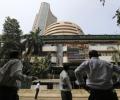
'It is easy to dramatise the events of today, but it is far more important to focus on the fact that we have a radically overvalued financial sector. It is a house of cards.'

Experts say foreign investor sentiment was bolstered by the US Federal Reserve's decision to go slow with interest rate hikes and hopes of political stability.

If Chinese growth starts falling, sharply or otherwise, the risk on trade might reverse.

'This encourages escapism through the politics and economics of nationalism, made worse by tribalism or nativism, the package accompanied inevitably by the erosion of institutional bulwarks and therefore State capture by powerful businessmen,' notes T N Ninan.
